An AI-assisted system for discovering, researching, and qualifying U.S. importers from fragmented public and trade data.
Verified product milestone
Internal Beta · v0.2.0Real-user validation in progress
Latest engineering candidate
v0.3.0-alpha.2 · Deployment candidateOngoing engineering workThe latest alpha contains ongoing engineering work and is not presented as completed user validation.
Role
Product / Workflow / AI Agent / Full-stack Coordination
Freight forwarders often spend hours manually searching for importers, checking websites, reviewing trade signals, finding decision makers, and writing outreach messages. The process is fragmented, repetitive, and difficult to scale.
01Fragmented data
02Manual research
03Weak qualification
04Repetitive outreach
05No closed-loop workflow
03 / Insight
The product should surface opportunities, not another company list.
A long database of importers does not reduce the hard part of the job. The useful unit is a qualified opportunity: a company with explainable trade evidence, a relevant decision maker, and enough context to support a credible next action.
04 / Product Decision
Product decisions that shaped the MVP
/Prioritize opportunities instead of a simple company list.
/Qualify first, then generate outreach.
/Keep a human review point before approval and export.
/Split search, analysis, enrichment, and writing into bounded Agents and tools.
/Close the MVP workflow before expanding automation.
/Use a bilingual interface designed for Chinese freight-forwarding teams.
05 / Workflow
From an input request to an auditable outreach result.
Each stage produces evidence or a decision that the next stage can use. Human review remains explicit rather than being hidden behind automation.
01
Input request
→
02
Find candidate importers
→
03
Research company
→
04
Analyze trade opportunity
→
05
Find decision makers
→
06
Generate personalized outreach
→
07
Human review
→
08
Export result
06 / Architecture
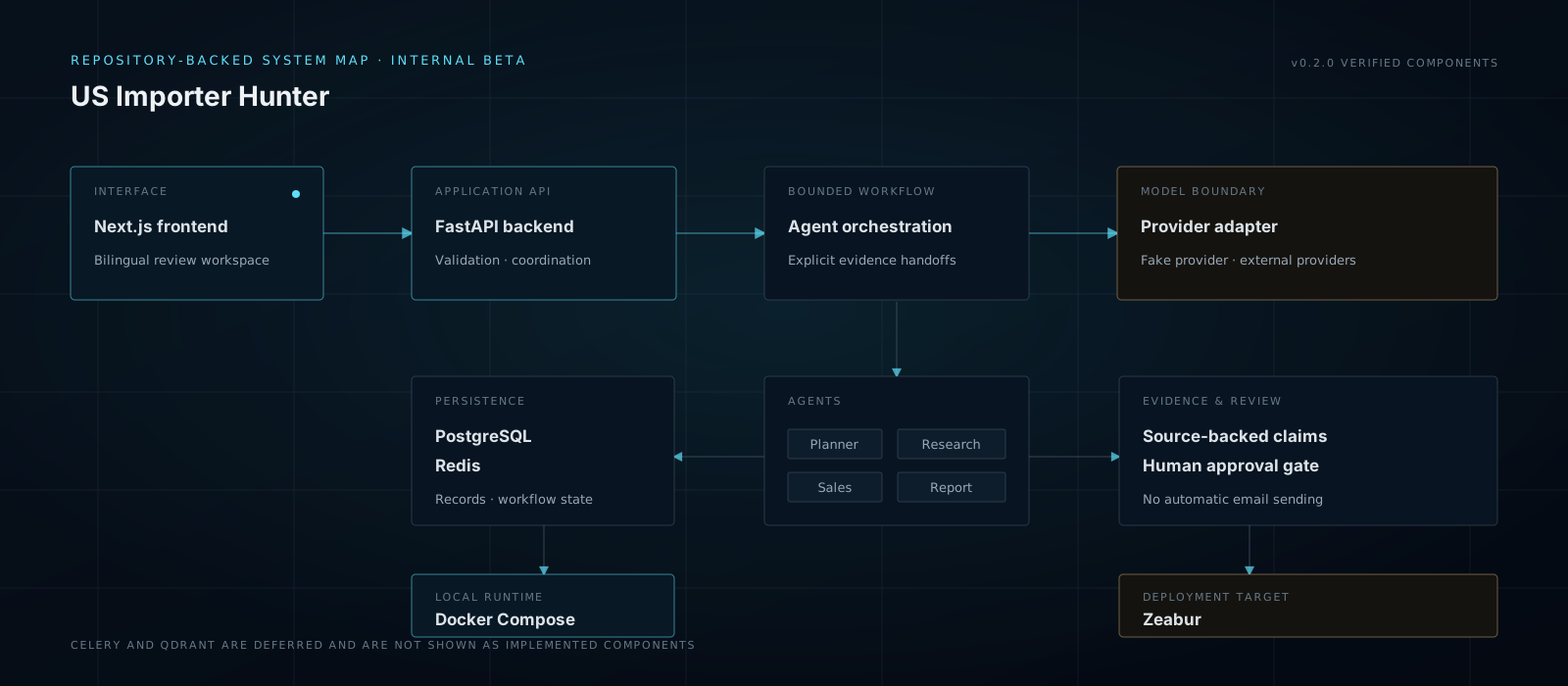
A practical monorepo architecture for a workflow product.
The system separates interface, API, persistence, orchestration, and deployment responsibilities without inventing infrastructure the current product does not use.
Frontend
01
Next.js
React
Bilingual workflow UI, review states, and result handling.
→
Backend
02
FastAPI
Workflow endpoints, validation, and service coordination.
→
Data
03
PostgreSQL
Redis
Persistent records plus short-lived workflow state.
→
Agents
04
Planner
Research
Sales
Report
Bounded capabilities connected through explicit evidence.
→
Provider
05
Provider adapter
Swappable Fake and external providers keep workflow testing separate from model quality.
→
Infrastructure
06
Docker Compose
Zeabur
Local service composition and current deployment work.
07 / My Contribution
Product ownership across the full AI-native build loop.
My contribution is the product and coordination layer that turns the business problem into a working, reviewable system—not a claim that every line of low-level code was written alone.
AI-native building and product ownership
01Business problem discovery
02Product definition
03Workflow and Agent design
04Feature prioritization
05AI-assisted implementation coordination
06Frontend and backend acceptance
07Deployment and iteration
08User experience review
08 / Product Evidence
Repository-backed product evidence from the Internal Beta.
Synthetic demo data · Fake Provider · No email sent · Engineering evaluation, not customer production results.
Opportunity workspace
Feature: Workspace and research entry
Internal Beta · repository demo data
The bilingual local workspace exposes Fake mode and keeps the research-to-review workflow explicit.
Qualification result
Feature: Evidence-backed qualification
Engineering validation · Fake Provider
A completed synthetic-company evaluation shows the score, confidence, completeness, recommendation, and supporting signals.
Draft review
Feature: Human review before approval
Internal Beta · no email sent
The generated outreach draft remains gated by a named human reviewer and is never sent automatically.
Website research claims
Feature: Evidence-backed website research
Internal Beta · Fake Research workflow
Public Klein Tools pages are converted into source-linked claims with confidence and Accept, Edit, or Reject controls.
09 / Current Result
Engineering validation is complete; real-user product validation is not.
01v0.1.0 browser MVP workflow
02v0.1.1 Chinese scoring and isolated E2E
03v0.2.0 Website Research Agent Internal Beta
0410-company engineering evaluation completed
05Evidence-backed human review verified
06Real-user validation in progress
07Public deployment and broader automation incomplete
Engineering validation
Completed for the v0.2 evaluation set
Ten public companies were engineer-selected and engineer-reviewed to verify safe completion, evidence handling, and the review workflow. This is not customer validation.
Real-user product validation
In progress
The repository contains a validation plan and template, but no real-user results are recorded yet.
What I Learned
What the build clarified
/Automation is not the same as removing every human decision.
/Data quality determines AI qualification quality.
/MVP speed matters more than architecture perfection.
/AI agents need clear boundaries and evidence.
/Product value comes from workflow closure, not model novelty.
Next Step
Validate the workflow with real users before broader automation
The next step is to collect honest real-user feedback, improve trade-data evidence, and raise workflow reliability before public deployment or additional autonomy.