Published
Building US Importer Hunter: From Manual Prospecting to an Evidence-Backed AI Workflow
Freight forwarders do not lack company names. They lack a reliable way to turn fragmented signals into qualified opportunities and actionable outreach.
The original workflow was repetitive: search for importers, inspect websites, interpret trade signals, find decision makers, draft messages, and repeat. The real challenge was not generating more leads. It was creating a workflow that could preserve evidence, support judgment, and move from research to action.
- AI-Native Building
- Global Trade
- Product Decisions
- Human Review
01
The Problem Was Not Search
Google, company directories, and trade-data tools can produce many company names. That makes search look like the main bottleneck, but the list is only the beginning. A freight forwarder still has to decide which companies have a plausible shipping need, whether the evidence is recent enough to matter, and what next action is credible.
A company name is not an opportunity. Without evidence and qualification, a longer list simply transfers more work to a person. Every weak candidate still has to be opened, checked, interpreted, and discarded. The apparent gain in coverage becomes a larger manual review queue.
- Discovery produces candidates, not decisions.
- A website can describe a business without proving current import activity.
- More rows do not reduce the cost of weak qualification.
02
From Lead List to Opportunity System
I started treating the opportunity—not the company—as the product's central object. An opportunity combines a candidate company with research, qualification reasoning, evidence, unknowns, a recommended action, and a review state. That structure makes the next decision visible instead of hiding it inside a spreadsheet cell.
The sequence also matters. Research and qualification happen before outreach generation. Each conclusion should carry a source whenever possible, and uncertain fields should remain unknown. Asking AI to fill every blank may make the interface look complete, but it weakens trust precisely where the workflow needs judgment.
- Research before writing outreach.
- Attach evidence to conclusions whenever the source supports it.
- Preserve unknown as a valid state instead of guessing.
- Make the next human decision part of the product model.
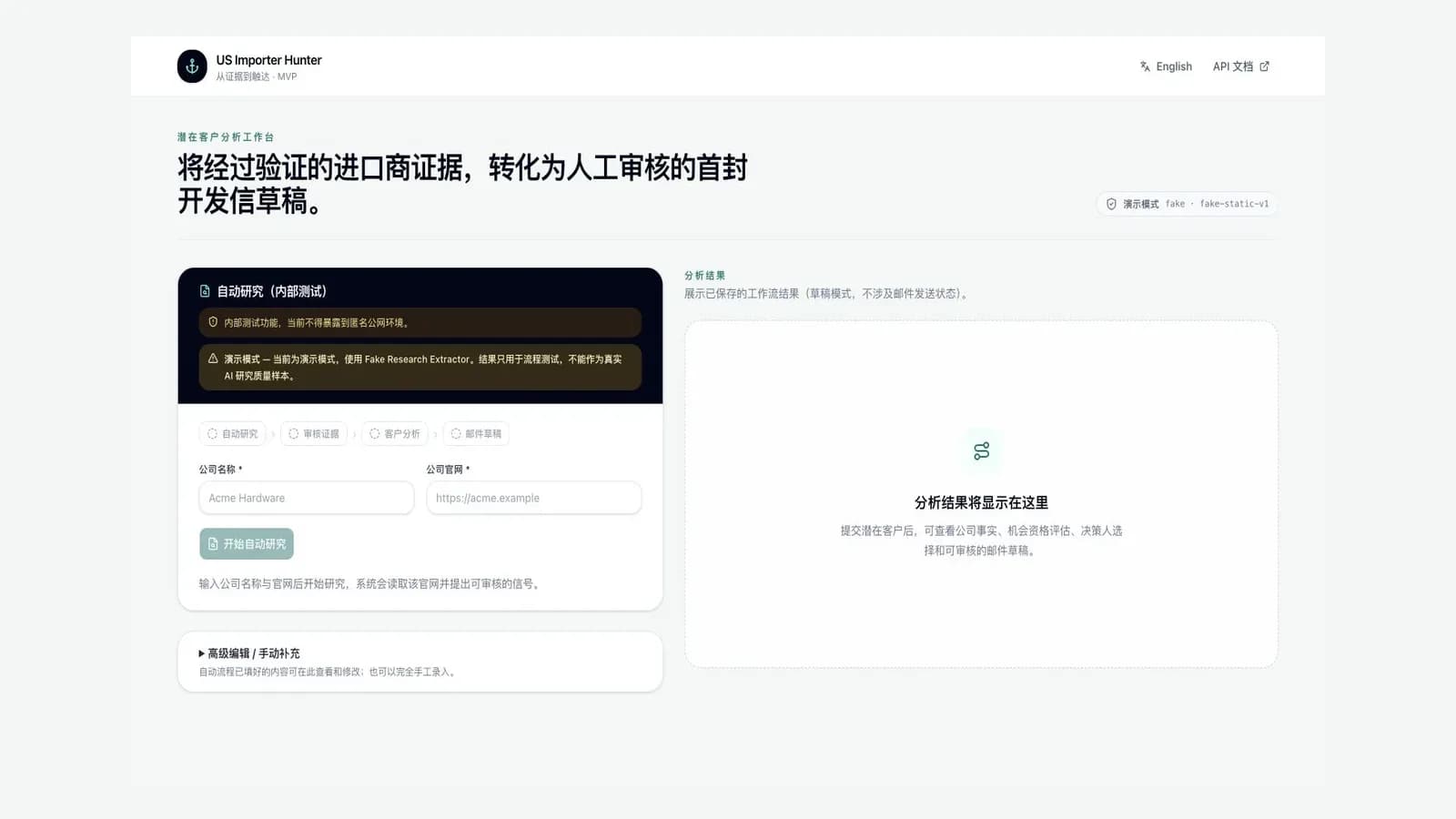
Opportunity Workspace
- Synthetic demo data
- Fake Provider
- No email sent
The real local workspace keeps research, qualification, and review states visible instead of collapsing them into a lead row.
03
Why Human Review Stayed in the Loop
AI can compress the time required to inspect pages, organize signals, explain a score, and prepare a draft. It cannot automatically prove that every public claim represents an import fact. A company website may describe manufacturing, sourcing, expansion, or product categories; those statements are useful context, but they are not interchangeable with customs records.
Accept, Edit, and Reject are therefore product decisions, not temporary patches. They give the reviewer a controlled place to distinguish evidence from inference, correct a claim, or refuse it entirely. Automation is valuable when it reduces repetitive work while preserving accountability—not when it silently removes every human judgment.
- Public website evidence and trade facts remain distinct.
- Confidence helps prioritize review; it does not make a claim true.
- Human review is an explicit workflow state.
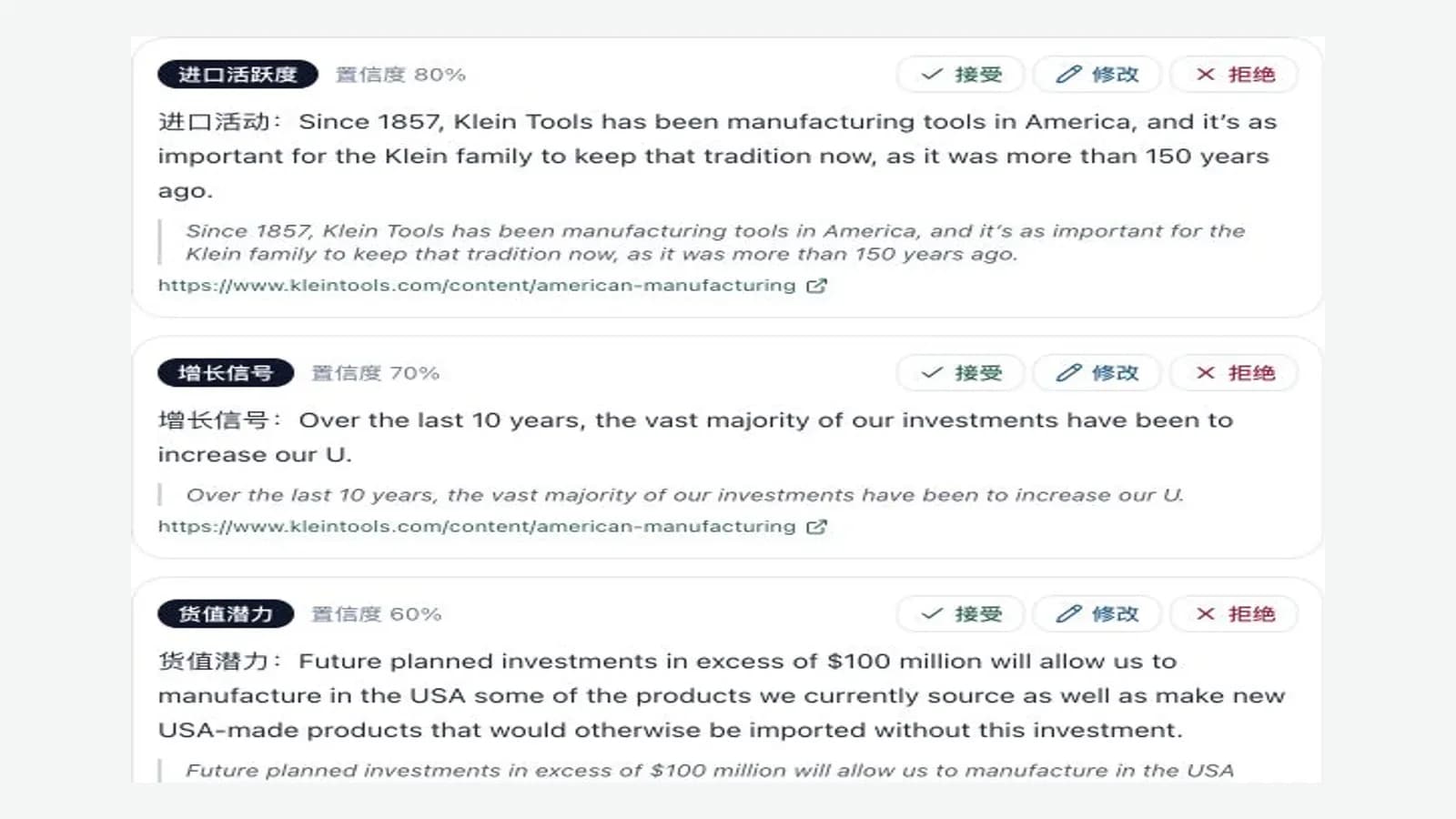
Research Claims
- Synthetic demo data
- Fake Provider
- No email sent
Source-linked website claims retain confidence and Accept, Edit, or Reject controls for human verification.
04
Building the MVP Loop
The first useful milestone was not a fully autonomous agent. It was a closed, reviewable loop that could carry one candidate from input to a persisted result. The interface needed to show where evidence came from, what the system concluded, and what remained under human control.
The current system does not automatically send email. A Fake Provider makes it possible to test the workflow safely without presenting synthetic output as model-quality evidence. The Next.js and FastAPI flow is connected, and PostgreSQL persistence has been verified through reload and review paths.
- 01Input request
- 02Find or enter candidate company
- 03Research public evidence
- 04Evaluate qualification
- 05Generate outreach draft
- 06Human review
- 07Approve
- 08Reload and verify persistence
05
What AI-Native Building Changed
AI-native building changed the distance between a product decision and a working implementation. One person can hold product definition, workflow design, acceptance criteria, interface review, and iteration coordination while using AI to accelerate research, implementation, and testing. That is a meaningful change in leverage.
It does not remove product judgment. Implementing the wrong direction faster still produces the wrong product faster. The important work is deciding what the system may claim, where evidence is required, which unknowns must remain visible, and what counts as acceptance. Clear boundaries and verification matter more than model novelty.
- AI compresses implementation cycles; it does not choose the product truth.
- Acceptance criteria turn fast output into accountable progress.
- Agent boundaries are useful only when their evidence handoffs are clear.
06
What Is Still Unfinished
US Importer Hunter remains an Internal Beta. Real freight-forwarder validation is still in progress, and the public demo has not been formally opened. The Website Research workflow still requires human review, broader automation is incomplete, and automatic email sending has not been implemented.
Public website evidence alone cannot prove a company's import records. The latest alpha is an engineering deployment candidate, not evidence that user validation is complete. Keeping those distinctions visible is part of the product work, because a credible system should communicate its limits as clearly as its capabilities.
- No fabricated customer, revenue, or conversion results.
- Engineering evaluation is not real-user product validation.
- No claim of automatic outreach or completed public deployment.
07
What I Learned
The build reinforced a set of principles that apply beyond this product. Data quality sets the ceiling for AI quality, and workflow closure matters more than an impressive output that cannot move into a reviewed next step.
- Data quality sets the ceiling for AI quality.
- Workflow closure matters more than isolated model output.
- Unknown is a valid product state.
- Human review can be a feature.
- MVP speed should not remove evidence requirements.
- Building in public forces clearer product thinking.
08
Conclusion
US Importer Hunter is still evolving. The most important result so far is not a larger database of companies. It is a clearer system for moving from fragmented signals to evidence-backed human decisions.
That distinction shapes what I build next: better evidence, more reliable qualification, and honest real-user validation before broader autonomy.